Can a robot bless you? Come and learn about the potential and pitfalls of using AI in our churches
Rev Dr Peter Phillips // July 18, 2026, 4:56 pm
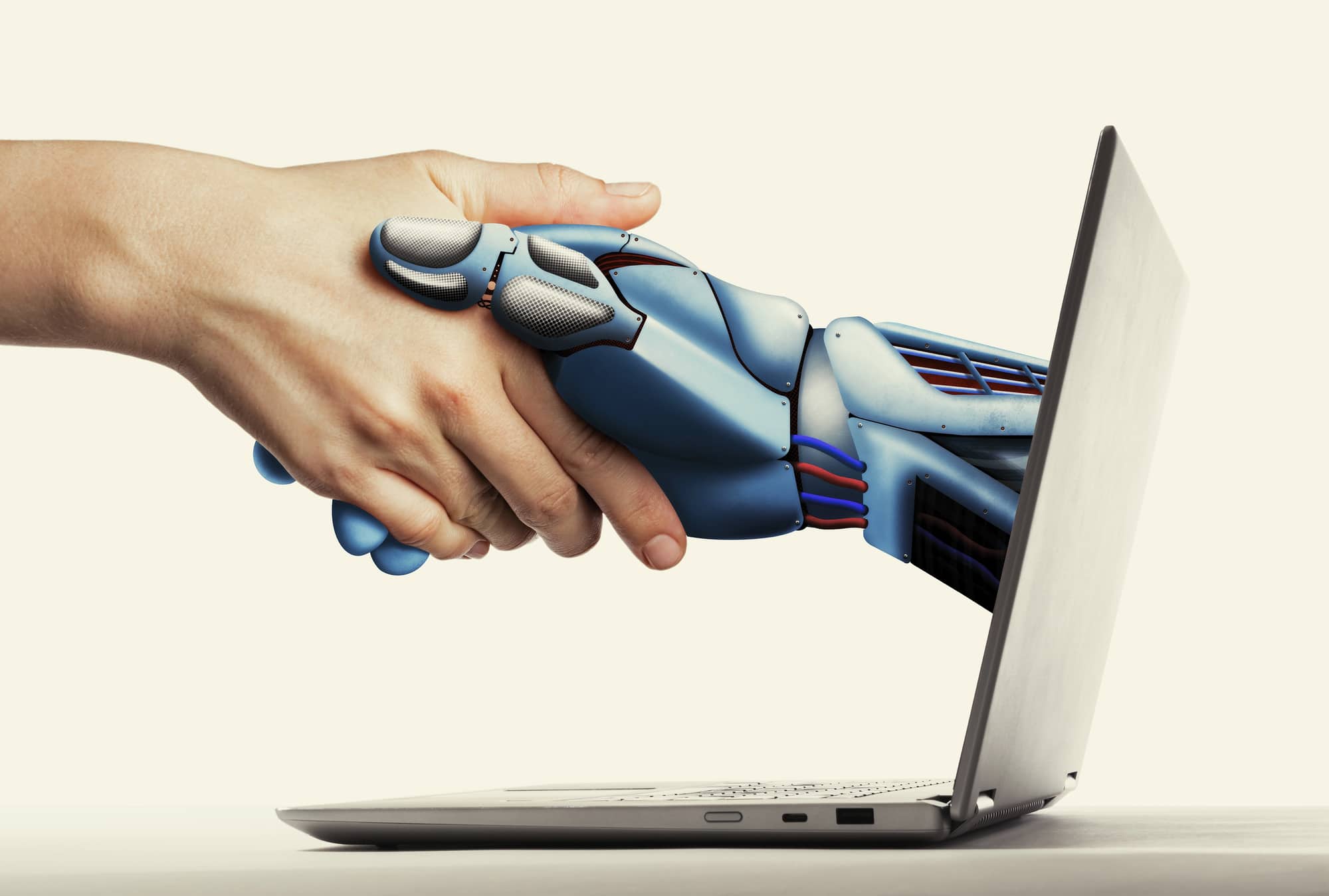
Organised by Biblical Graduate School of Theology and Bethesda (Katong) Church, this conference invites attendees to examine the role and use of AI in their spiritual lives and church ministries. Photo from Depositphotos.com.
A few years ago, at the height of the Reformation anniversary celebrations, pilgrims in the German town of Wittenberg found themselves queuing for something rather unexpected.
Not a shrine. Not a preacher. A robot.
BlessU-2 stood in a glass booth. It raised its arms. It flashed its lights. And then it printed out a benediction, in one of five languages.
I have read the accounts from people who stood in that queue. Many of them said afterwards that they really did feel blessed.
I want to pause on that. Because I think it matters more than we usually let it.
Feeling blessed and being blessed are not automatically the same.
Dr Ilona Nord at Julius Maximilian University of Würzburg has studied exactly this kind of encounter. She does not dismiss what people reported – as feelings or even as promptings of God. Nor should we.
But here’s the thing. Feeling blessed and being blessed are not automatically the same. That gap is where I think digital theology still has real, unfinished work to do.
Dr Heidi Campbell at Texas A&M University put it well. We should not rush to either extreme here.
What does it mean to be human in an age of AI?
On one side sits a temptation. Say the robot did it. Say technology has simply taken over a human, pastoral and sacred act. I want to resist that – and not for sentimental reasons.
We are knit together with the imago Dei, the very image of God, woven into the core of who we are. That is not a role a machine can simply absorb. How, after all, do you code the imago Dei in Python?

On the other side sits an equally tempting mistake. Assume that because a robot cannot bless, nothing of God could possibly have been at work in that queue. I am not so sure about that either.
Because is not the Bible itself a kind of technology? God’s Word, printed on paper. Mechanically reproduced since Gutenberg. Carried in coat pockets. Now read from glowing screens.
Nobody thinks the printing press possesses divine agency. And yet none of us doubts that Scripture – printed by a machine, delivered by an imperfect human voice – still manages to be the living Word of God to those who receive it.
God seems remarkably unbothered about the dignity of His chosen instruments.
So when you stand up to preach your next sermon, printed notes in hand, uncertain whether you have got it right, is it really so strange to imagine God using even that imperfect vehicle to speak to his people?
But what if those notes were drafted with Claude? Or ChatGPT?
God spoke through Balaam’s donkey. Through a burning bush. Through a still small voice. If Scripture is any guide, God seems remarkably unbothered about the dignity of His chosen instruments.
What if it is sometimes His will to bless us through a robot? To speak to us through AI? To care for us through a health support animatronic sitting quietly by a hospital bed?
An invitation to examine how AI can be adopted wisely
This is exactly the territory we will explore together in the AI and the Church Community conference, which will be held on August 15 and 22. Over two Saturdays, we will move from foundations to lived practice.
On the first Saturday, we will ask where wisdom is to be found in an age of AI, get under the hood of the science itself, and be honest about both the everyday usefulness and the real downsides of these tools.
We will even have theological conversations, live, with Claude and Grok – and sit with the harder question of whether AI itself could ever be converted.
On the second Saturday, we turn to the Church directly, with case studies and a panel on the role of AI in ministry.
We hear from Venerable Daniel Wee, Archdeacon of the Anglican Diocese of Singapore; Carol Loi, a digital wellness educator who works with families; and Dr Lai Pak-Wah, Principal and Lecturer in Church History and Marketplace Theology at the Biblical Graduate School of Technology (BGST).
There will also be a session I suspect may matter most of all, titled “Authority, Pastoral Care and the Irreplaceable Human”.
Finally, we will close each day the old way – with the Examen. Because reflection, not just information, is how wisdom forms in us and informs us.
We will not settle any of this too quickly. And we certainly will not arrive with tidy answers.
But we will think carefully, together, about what it means to be human – and to be blessed – in an age when machines are starting to speak in sacred registers.
Come and wrestle with this alongside me. We would love to see you there.
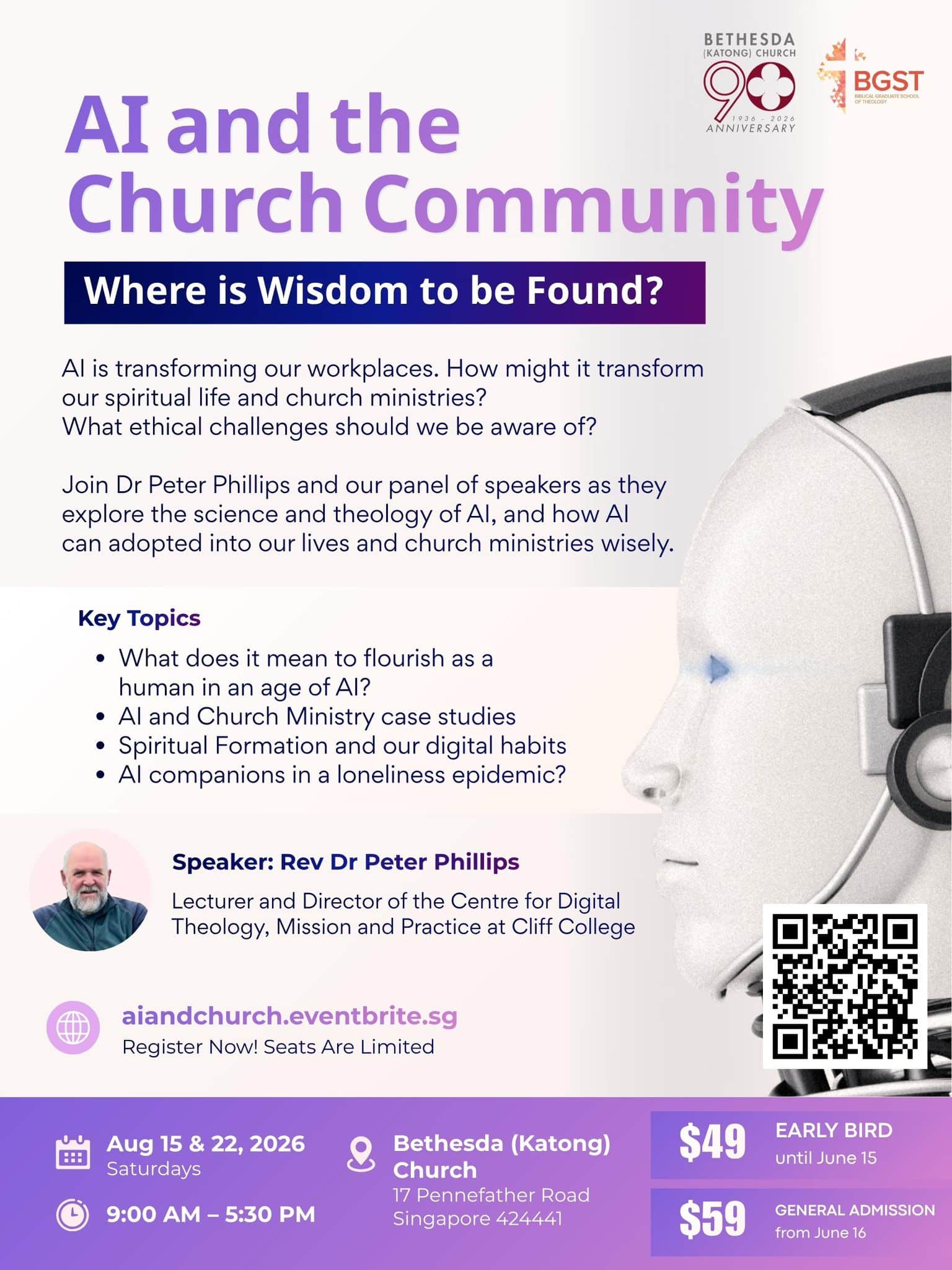
Organised by Biblical Graduate School of Theology (BGST) and Bethesda (Katong) Church, “AI and the Church Community” will be held on August 15 and 22, 2026. For more details, click on aiandchurch.eventbrite.sg or scan the QR code in the poster.
READ MORE:
They want to expand the global reach of quality Christian content with the help of AI translation
The Bible doesn’t talk about tech and AI, so what should we do?
“Throw ourselves into the digital world because that’s where God is”: ChristianX 2019
This year, as we celebrate 10 years, consider sowing into our Kingdom ministry! For S$10 a month, you become part of the #10for10 community and a part of every story we tell.
Partner with us
Related Articles

The theology of digital missions – and why it matters more than ever

The future of children’s ministry: Discipling kids in a digital world needs a different kind of shepherd

Science asks the big questions that only faith can answer, says astrophysicist, theologian and Methodist minister Rev Prof David Wilkinson
