Is parenthood still a prize worth pursuing or a price too high to pay?
by Gracia Chiang // March 31, 2026, 4:58 pm

If we want to encourage and empower more Singaporeans to have children, approaches will need to be customised to meet the needs and concerns of different demographics, says Cultivate SG. Photo from Depositphotos.com.
While much of the discussion on Singapore’s record-low total fertility rate (TFR) has centred on the financial concerns over bringing up children, a new report puts the spotlight on other key factors for parenthood aversion.
Building on their Marriage, Parenthood and Success Report that was published last year, Cultivate SG‘s supplementary analysis explores how respondents of different life status and marriage and parenthood orientation differ in their perceptions of the value and cost of parenthood.
Released on March 28, the report argued that “parenthood aversion is not merely about the affordability of children”.
“It is whether Singaporeans believe that family life is worth re-ordering their lives around and for.”

Some reasons given by married respondents who have no aspirations for parenthood. Source: Cultivate SG
In other words, when parenthood is perceived as a prize, it becomes “price inelastic” (less sensitive to the costs and challenges of parenthood). Conversely, when parenthood is not prized, it becomes highly “price elastic” (more sensitive to the costs and challenges of parenthood).
In its 2025 survey, the non-profit organisation interviewed 2,019 Singaporean and Permanent Residents aged 21-45.
However, only four groups totalling 640 respondents were analysed in this latest report:
- Potentially Married, No Child (PMNC): Singles who aspire to marry but not to become parents.
- Married, No Child (MNC): Married individuals with no child and no aspirations to become parents.
- Married, No Child Yet (MNCY): Married individuals without children but aspire to become parents.
- Married Parents, High MPO (MP-H): Married parents with a strong marriage and parenthood orientation (MPO).
(To understand more about MPO and the impact of religion on MPO levels, read last year’s report.)
Zooming in to these four respondent groups, here are some of the key findings from this year’s report.
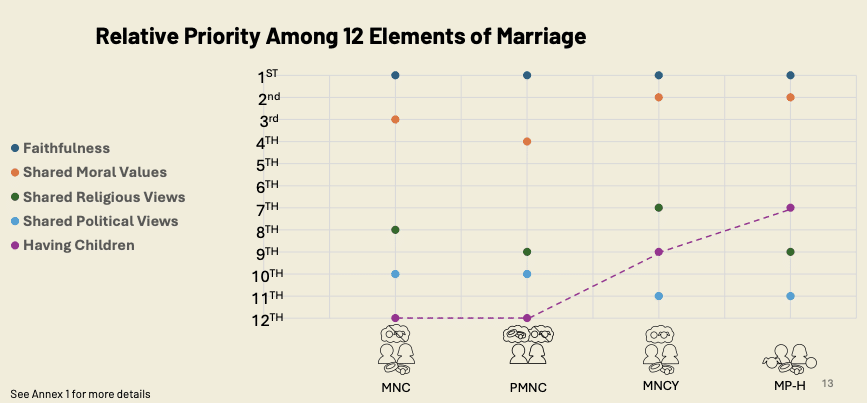
Elements of marriage are similarly valued, except “having children”
All four groups generally agree on the core elements of a marriage, with “faithfulness” as the top priority). However, the clearest difference is the importance of parenthood in a marriage.

Singles and married individuals who do not aspire to become parents (PMNC, MNC) rank “having children” as the lowest priority in marriage, while married parents (MP-H) rank “having children” in the middle.
Source: Cultivate SG
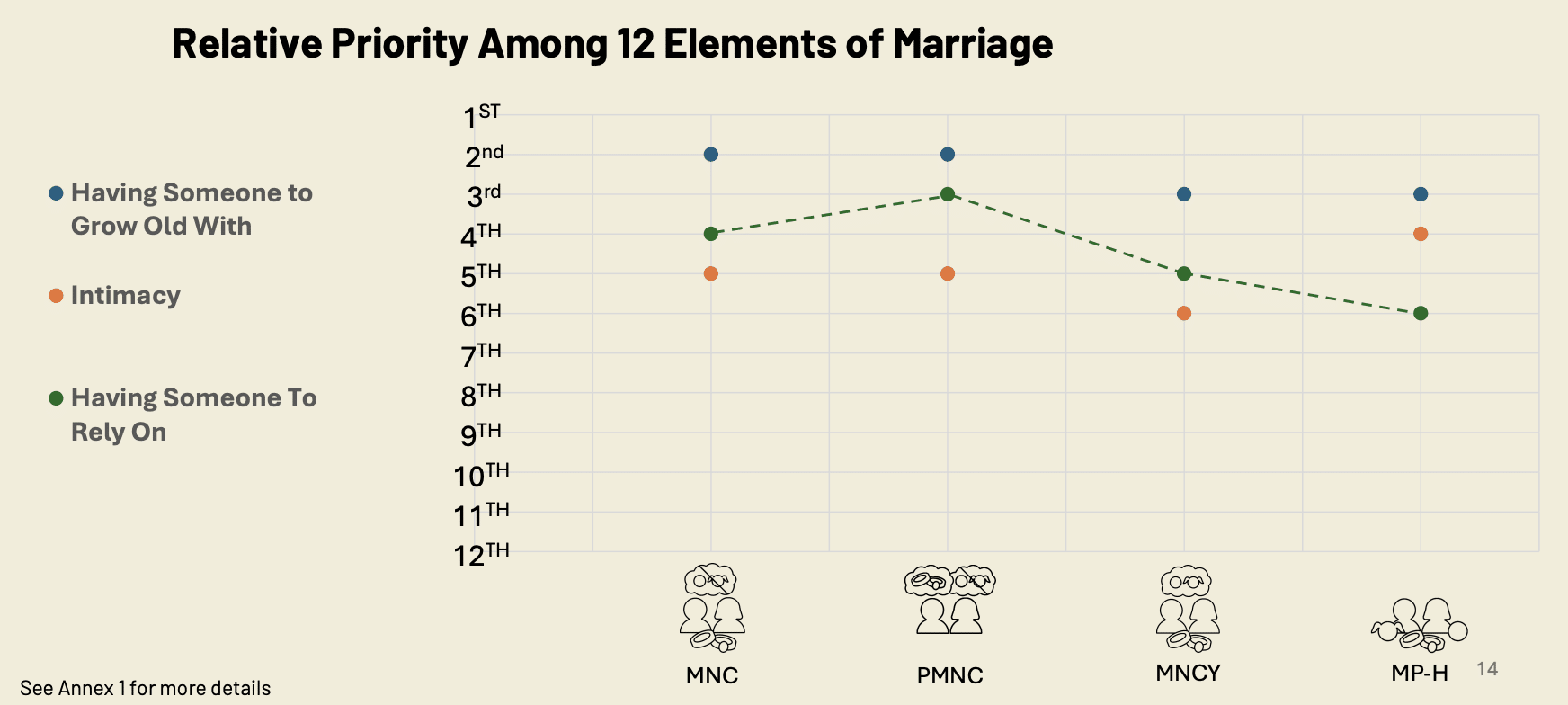
Couple-centric elements (“having someone to grow old with”, “intimacy” and “having someone to rely on”) are also similarly valued, but those who are more parenthood-oriented are less concerned about “having someone to rely on”.
Source: Cultivate SG
Different priorities matter when defining success in life
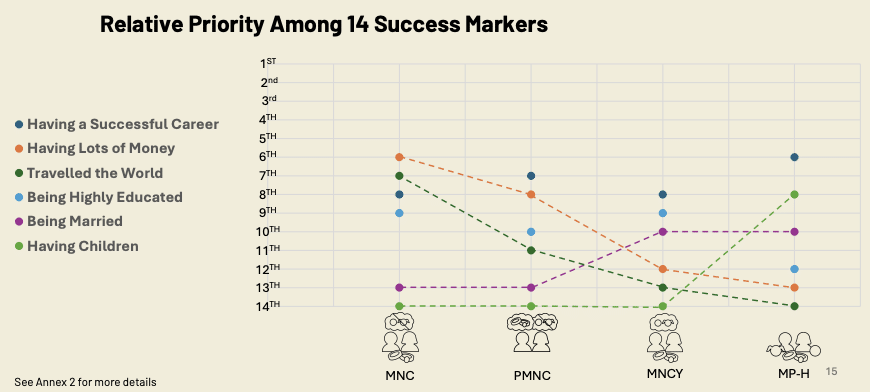
In terms of how they see success, those without parenthood aspirations place more emphasis on material and lifestyle attainment, and are significantly more concerned with the practical-economic costs of parenthood.
For instance, married individuals with no aspiration to have children (MNC) rank “having lots of money” and “travelled the world” the highest compared to the other three groups, while married parents (MP-H) rank these in lowest priority as markers of success.
Source: Cultivate SG
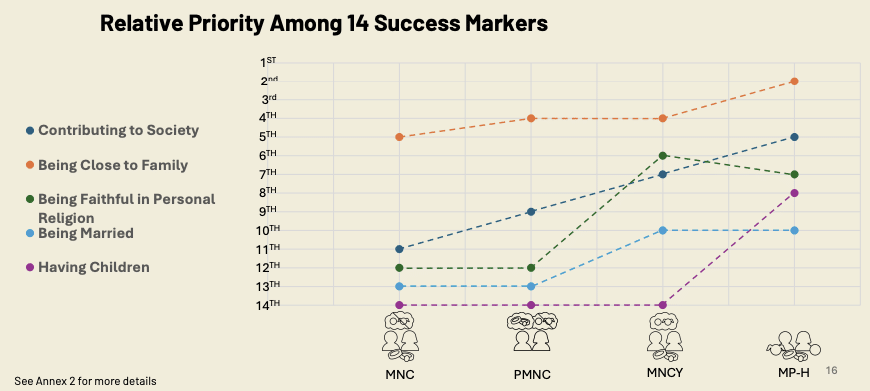
On the other hand, those who prioritise marriage and parenthood tend to view community- and other-centric elements as success markers.
Compared to other groups, married parents (MP-H) rank “being close to family” and “contributing to society” the highest.
Source: Cultivate SG
Parenthood hesitation is first economic, but confidence and health are important too
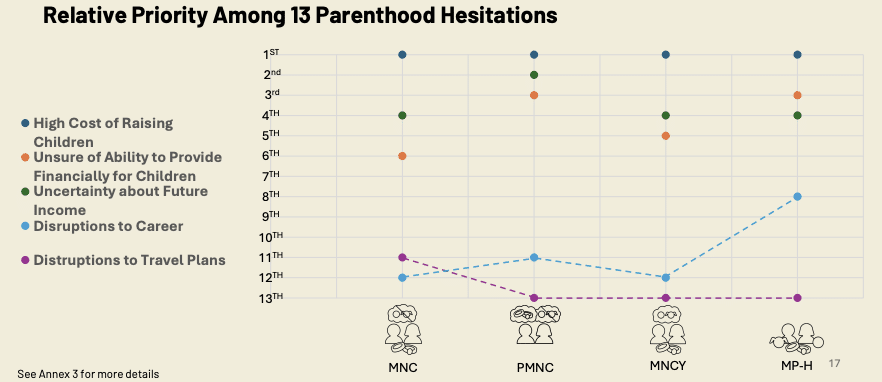
Although the “high cost of raising children” emerged as the top factor discouraging parenthood across all four groups, those married and without children (MNC) are more sensitive about “disruptions to travel plans”, while married parents (MP-H) are more sensitive to “disruptions to career”.
Source: Cultivate SG
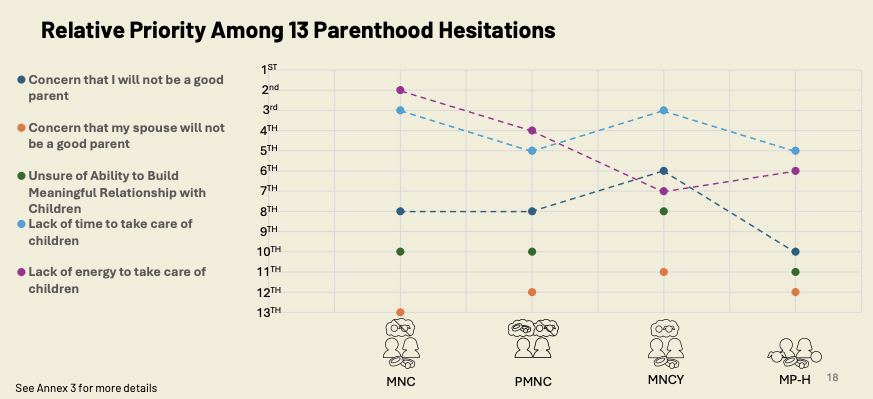
Concerns about ability and availability also affect non-parents more significantly.
Married individuals who desire children (MNCY) are most sensitive to the “lack of time to take care of my children” and “concern that I will not be a good parent”.
For those who do not aspire to become parents (PMNC, MNC), “lack of energy to take care of children” ranks highest, compared to those who are married and have yet to have children (MNCY) as well as married parents (MP-H).
Source: Cultivate SG
Differing views on how parenthood is related to marriage, positive effects of parenthood
The report also notes that those who aspire to become parents have significantly different views on the connection and impact of parenthood in relation to marriage, compared to those who do not.
For example, most agree that having children is a natural next step in marriage (except in cases of infertility); takes the marriage to a higher level; and strengthens the relationship between spouses.
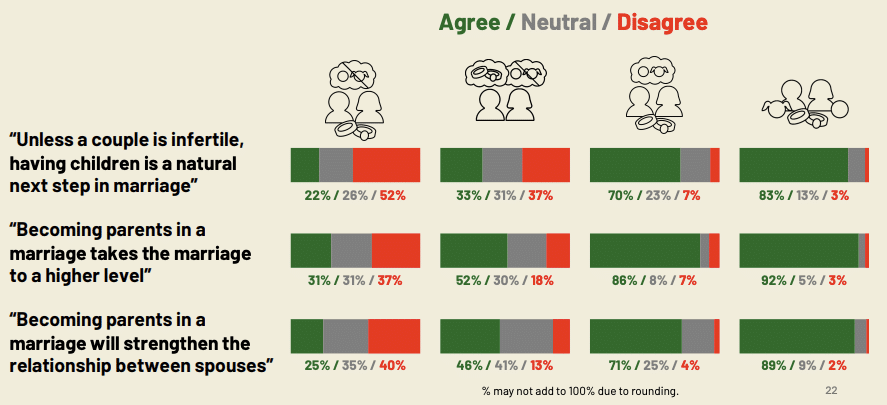
Source: Cultivate SG
Those who do not intend to have children also have a lower view of the positive transformative effect of parenthood, compared to married parents.
These range from making one a better person and giving one a sense of purpose in life, to motivating them to work harder at their job, spend money more wisely and quit bad habits.
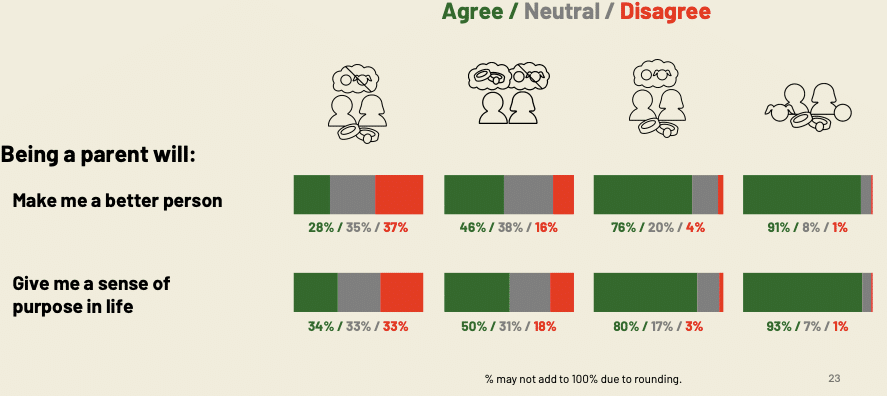
Source: Cultivate SG
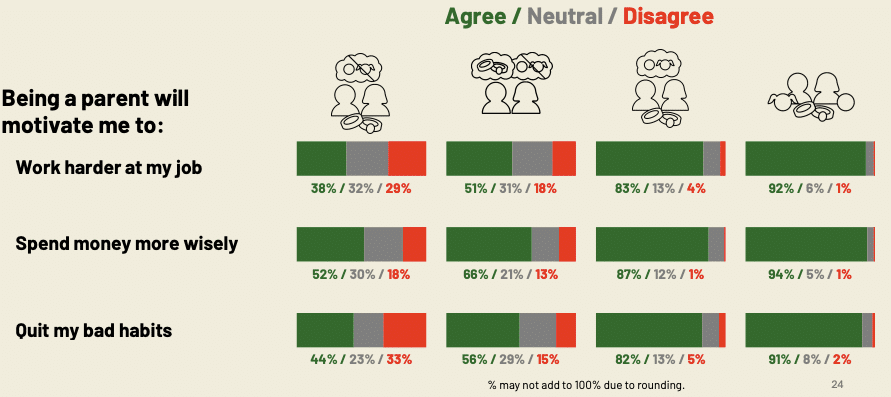
Source: Cultivate SG
Key takeaways
Having examined the different demographics, Cultivate SG proposes that approaches need to be tailored if Singapore wants to tackle its TFR problem.
After all, demography has to do with “values, priorities and parenthood aspirations of individuals”.
While Cultivate SG’s recommendations are largely directed at the private and public sector, here are some takeaways that can be extrapolated for churches and community organisations.
Reshape norms and narratives on marriage and parenthood
Addressing the practical-economic concerns as well as the preference for material and lifestyle attainment of those who do not have parenthood aspirations can include:
- Leading people to reflect on and relook values regarding success and priorities in life.
- Correcting the negative perceptions and promoting the intangible joys of family life.
Encourage family-friendly work rhythms
Aimed at those who desire children but are worried about career disruptions, shifting the prevailing work culture can look like normalising:
- Choosing part-time or contract jobs for those who need more flexible working arrangements to care for children.
- Taking of career breaks to become caregivers at home.
- Protecting personal and family time by having clear start and end times for jobs.
Empower people by connecting them with resources
To help those who may not have any parenthood aspirations or are delaying having children due to parenting-relational concerns, these are some things that can be done:
- Educating youths so that they understand the importance of planning for family earlier on in life, and can make better decisions about their career, etc.
- Creating opportunities for those who are hesitating to become parents to interact with and learn from married parents.
- Providing avenues for skills upgrading to married parents, whether in relation to marriage or parenthood.
- Encouraging grandparents to be more involved. This will hopefully increase the capacity of couples to raise children, not on their own but with the support of their extended family.
While the results are meaningful, Cultivate SG also acknowledges the limitations of its survey (eg language, age range, smaller sample sizes). Therefore, the report states that these results should be interpreted with appropriate caution.
For more insights, head over to the Cultivate SG website to read the full report.
RELATED STORIES:
Marriage and parenthood rank low among markers of success for Singaporeans: Cultivate SG survey
Singapore’s total fertility rate: A Christian response in a season of slow decline
“Please show us some good marriages”: 5 tips for churches and couples from State of the Family 2026
This year, as we celebrate 10 years, consider sowing into our Kingdom ministry! For S$10 a month, you become part of the #10for10 community and a part of every story we tell.
Partner with us