Turning setbacks into resilience: Marketplace leaders Ong Ai Boon, Reuben Lai and Oriana Suryo explain how
by Poh Fang Chia // May 5, 2026, 12:18 pm

The panel at School of Gatekeepers 2026 comprised Reuben and Oriana Lai of Arkadiah, and banking stalwart Ong Ai Boon. The session, facilitated by Evangeline Lee, reframed difficulties and trials as stepping stones for the believer in the marketplace. All photos courtesy of Gatekeepers Singapore.
Before Reuben Lai became the CEO and co-founder of Arkadiah, a nature-tech company restoring landscapes through AI, he faced a career setback he now describes as a “quite ridiculous” failure.
Having left a cushy corporate role at a multinational media and entertainment enterprise to launch a medical technology startup, Reuben soon hit a snag when he learned that they were legally prohibited from advertising medical services.
The workplace is a primary training ground where personal trials are converted into professional and spiritual resilience.
With a new baby at home and a failing business, the stress was immense. Yet, Reuben realised this closed door was a divine redirection.
“Whatever the enemy planned for evil, God will turn it into good,” Reuben noted.
This failure led him to join Grab when it was a small team, where he eventually became the Senior Managing Director of Grab Financial Group, growing the business into a unicorn.
Reuben shared his testimony at a panel discussion on April 11, 2026, organised by the School of Gatekeepers.
The session brought together veteran leaders Reuben Lai, Ong Ai Boon, Director of the Association of Banks in Singapore (ABS) and Oriana Suryo, Head of Business Development and Marketing at Arkadiah, to share how believers can experience God in the marketplace.
The panellists emphasised that the workplace is not a separate compartment of life where God is absent, but rather a primary training ground where personal trials cause the development of professional and spiritual resilience.
The power of transparency in corporate setbacks
Oriana provided a relatable perspective for those struggling with corporate setbacks, sharing her own journey of how God transforms personal trials into testimonies of praise.
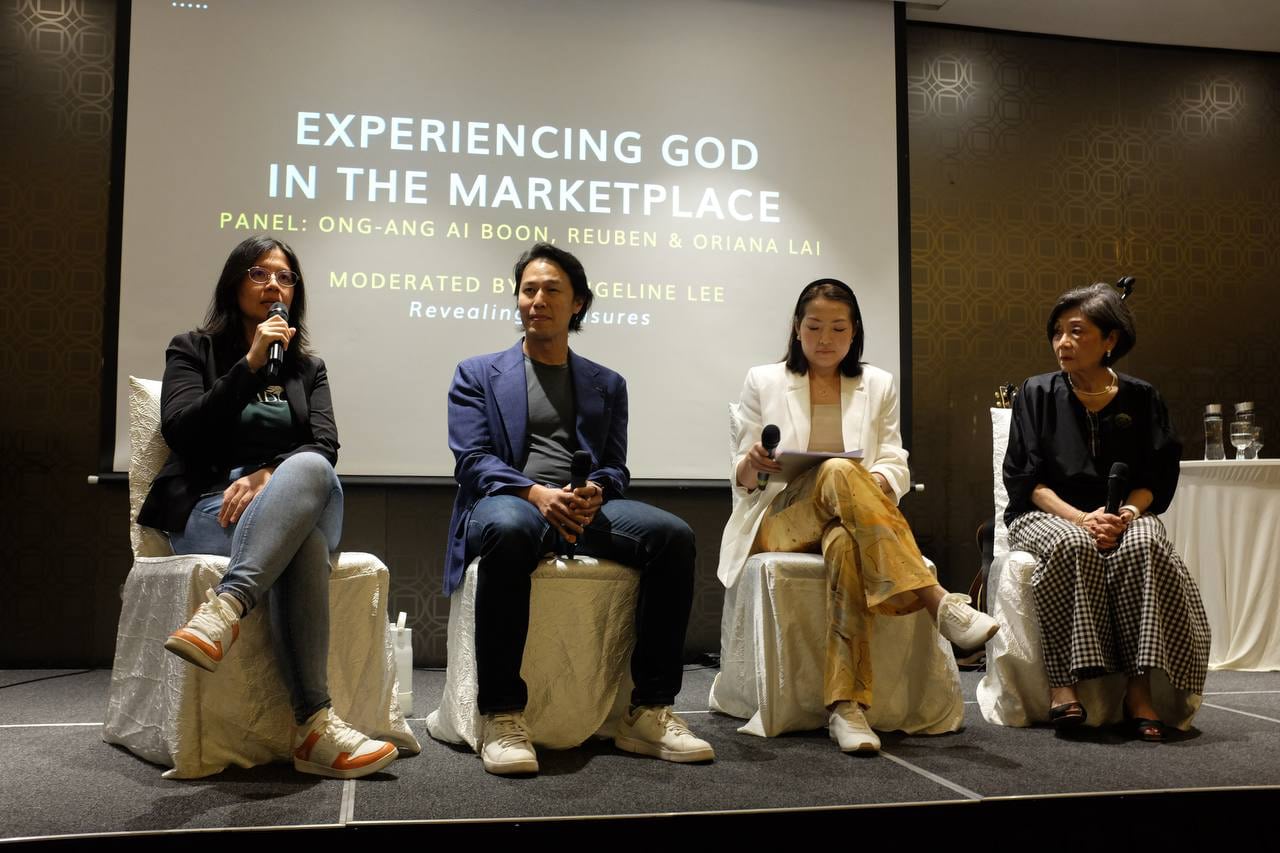
Oriana Lai (first from left) testifying to how God turns personal trials into praise.
Prior to joining Arkadiah, she revealed that she applied for a specific progression role within her team in a global financial institution and was rejected twice. It was only on her third attempt that she was successful.

When she eventually became the boss of her former peers — some of whom were more senior and tenured than her — she chose a path of radical transparency. In her first meeting as their leader, she told them the story of her repeated rejections.
By admitting her own struggles, she built a culture of psychological safety, encouraging her team that success is not a permanent state of peak performance and that resilience is more valuable than a perfect record.
Quick repentance and sincere apology
For Ai Boon, navigating workplace failure is not about damage control but about a deep-seated commitment to quick repentance and plain apology. She operates on the belief that a mistake only becomes a failure if a believer falls down and does not get up.
A mistake only becomes a failure if a believer falls down and does not get up.
When she realises an error has been made, her first action is to confront herself before God, asking for clarity on what went wrong and seeking a spirit of repentance rather than defensiveness.
She emphasised that believers should be “quick to say so” when they are wrong, whether they are speaking to subordinates or high-level governing authorities.
True repentance shows up at work as simple, honest apologies. Ai Boon rejects the temptation to hide mistakes, noting that the Lord encourages her to “not hide” and simply “tell the truth”.
By confessing weaknesses and apologising plainly, she found that she can actually accelerate trust and growth within her organisation. She recounted instances where she had to apologise to government departments for things she should not have said, choosing to humble herself and repent for her conduct.
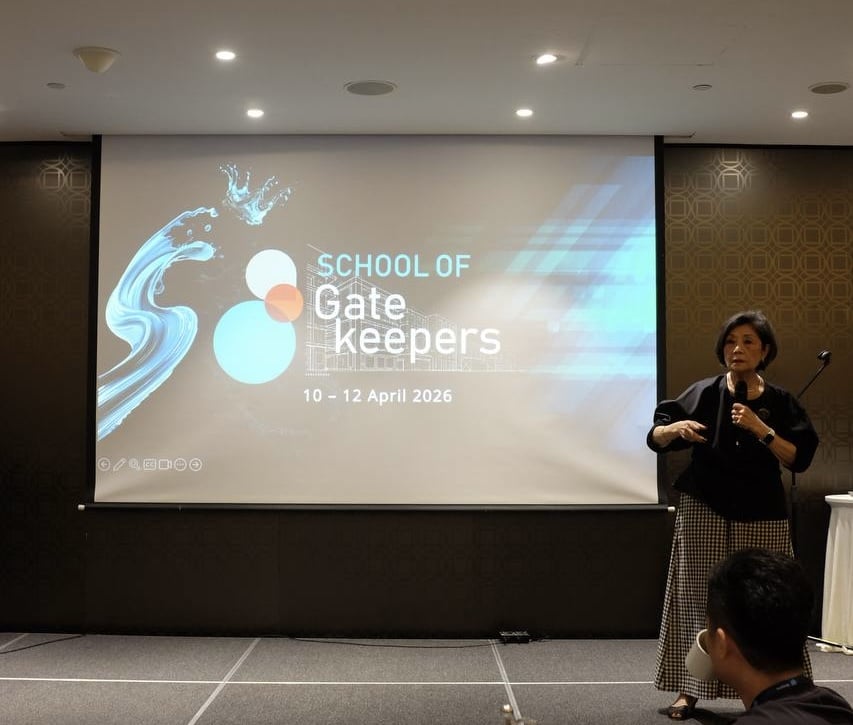
Ong Ai Boon spoke openly about her own weaknesses and how God used them to build strength and resilience.
She observed that when she humbled herself in this way, God often “took care” of the situation, sometimes even causing the other party to forget the offence and allowing a stronger relationship to emerge from the initial friction.
By modelling this lived faith, Ai Boon has created space for God to transform her moments of professional weakness into replicable testimonies of resilience and integrity.
3 strategies for thriving in the marketplace
To help marketplace believers navigate their own storms, the panellists offered three highly practical strategies:
1. Empty the blessing blockers
Ai Boon emphasised that many professionals remain stuck in their trials because they are hindered by internal obstacles she calls “blessing blockers”.
“Empty yourself . . . you’ll hear the Holy Spirit better.”
These include things like unforgiveness, envy, bitterness, a critical judgmental spirit and anxiety. To clear these, she recommended a discipline of writing copiously in a notebook.
By journaling her raw emotions – her anger, her frustrations with difficult colleagues, and her fears – she effectively “empties” herself.
“Your old self is a blessing blocker,” she noted. “Empty yourself . . . you’ll hear the Holy Spirit better.”
This practice of offloading emotions to God in writing helps the believer clear his ear and ensure that his actions is led by the Spirit rather than by ego.
2. Avoid double-mindedness
Ai Boon viewed “double-mindedness” as a state where a believer’s focus is fractured between the responsibilities of the office and the burdens of home, preventing them from being fully present or effective in either domain.
Ai Boon manages the tension between high-level financial projects and intense family trials – such as caregiving for her daughter-in-law with motor-neuron disease – by intentionally segregating her focus.
When she is at the office, she makes a conscious decision to entrust her family to God, telling Him: “You look after my family.”
Conversely, when she is at home, she entrusts her professional projects to Him so that her mind remains stable and focused on her family.
3. Move the ship
When faced with workplace failure or uncertainty, Reuben advised against remaining paralysed while waiting for a “perfect” word from God.

Stepping out in faith is a key element in experiencing God in the marketplace.
Drawing from the story of Jacob moving away from Canaan to Egypt at an old age, Reuben noted that Jacob was probably scared as he did not have a clear word from the Lord. It was only after he took the first step that he heard from God (Genesis 46:1-3).
“It’s easier to steer a ship in motion than when it’s anchored,” Reuben pointed out.
He encouraged the audience to take a baby step or a small faithful action towards a new goal. As a believer moves, God provides confirmation through circumstances, Scripture and the counsel of the community.
“God always confirms His Word. Always,” he assured.
The power of generational legacy
The panel concluded with a reminder that resilience is not just for the individual believer, but for the generations that follow.
When believers model resilience at home and at work, they become a lighthouse for their families and their organisations.
Ai Boon shared a story about her eight-year-old granddaughter, Megan, who witnessed her mother crying in her wheelchair during a difficult Christmas.
Megan sat at a table and scribbled a letter that read: “Dear Mummy, please don’t be sad . . . be like Joshua and Caleb. Trust in the Lord even though He appears not to be doing anything.”
This story underscored the concept of a generational faith transfer. When believers model resilience at home and at work, they become a lighthouse for their families and their organisations.
Ai Boon, who calls herself “digitally light” and a “digital dinosaur”, shared that she initially wanted to quit her role at the ABS because of the daunting digital age. However, she felt the Lord tell her that He would carry her. This led to her leading the launch of the Singapore FinTech Festival, an event that grew from 1,000 attendees to 75,000 globally.
Whether it is managing a “ridiculous” startup failure, overcoming promotion rejections, or dealing with personal mistakes, the message communicated by the panel was clear: Setbacks are God’s training ground.
By emptying the blessing blockers, trusting God and moving forward even when afraid, marketplace believers can transform their most difficult trials into their most powerful testimonies.
Registration for School of Gatekeepers 2027 is now open. Check out the details here.
RELATED STORIES
God minds our business: One CEO shares 3 truths for Christian business owners who feel stuck
She took the blame for her work partner’s shortcomings – and it rekindled his faith
This year, as we celebrate 10 years, consider sowing into our Kingdom ministry! For S$10 a month, you become part of the #10for10 community and a part of every story we tell.
Partner with us